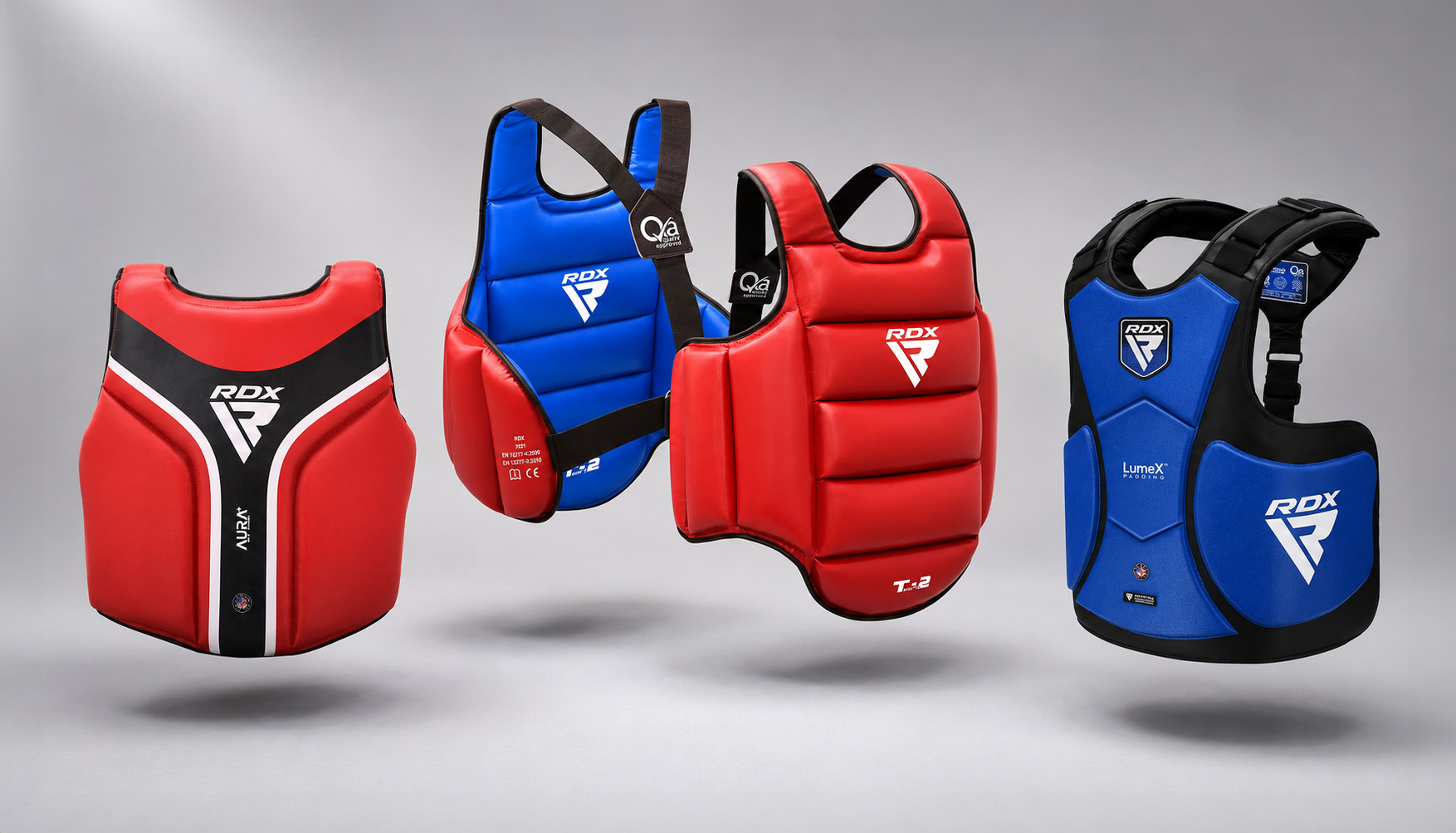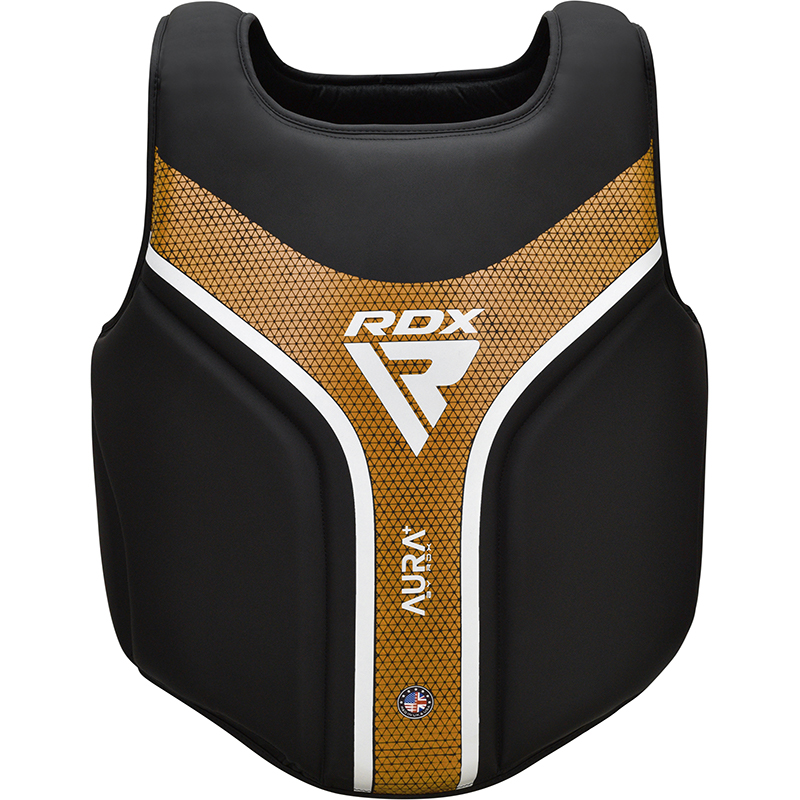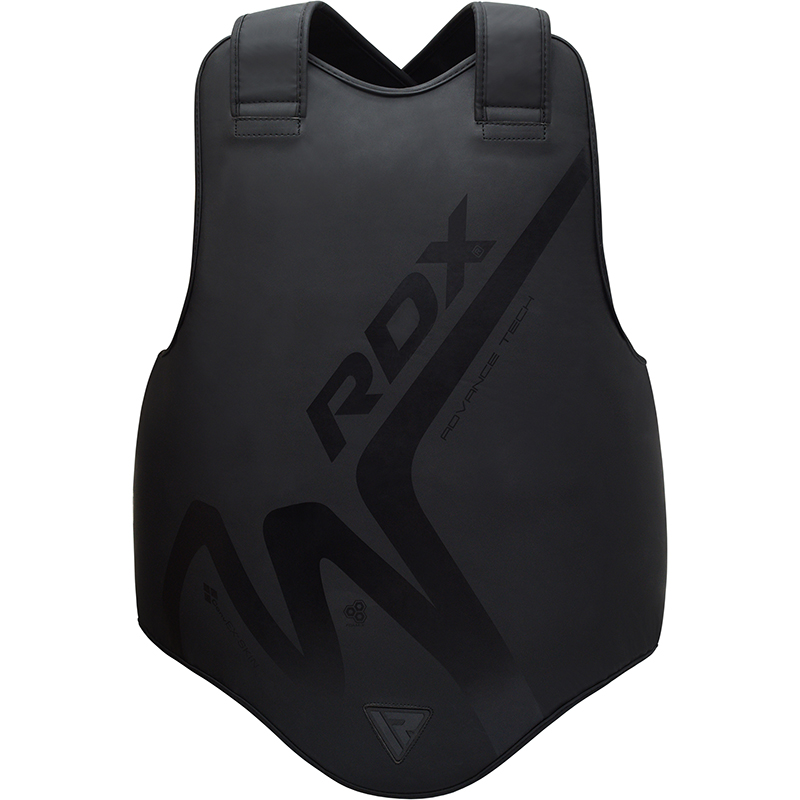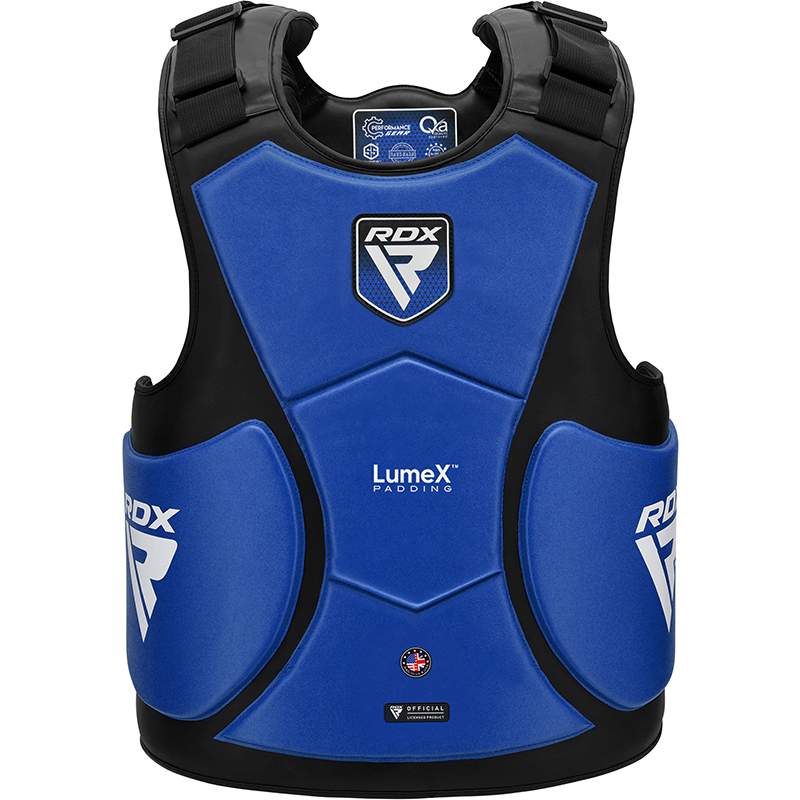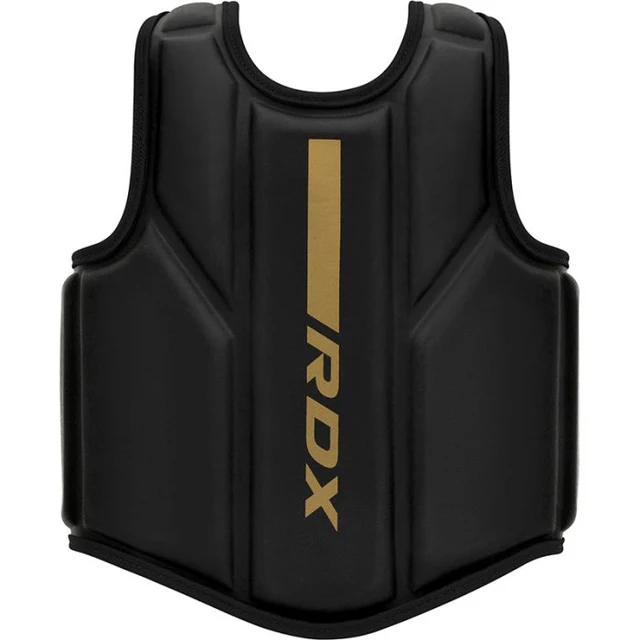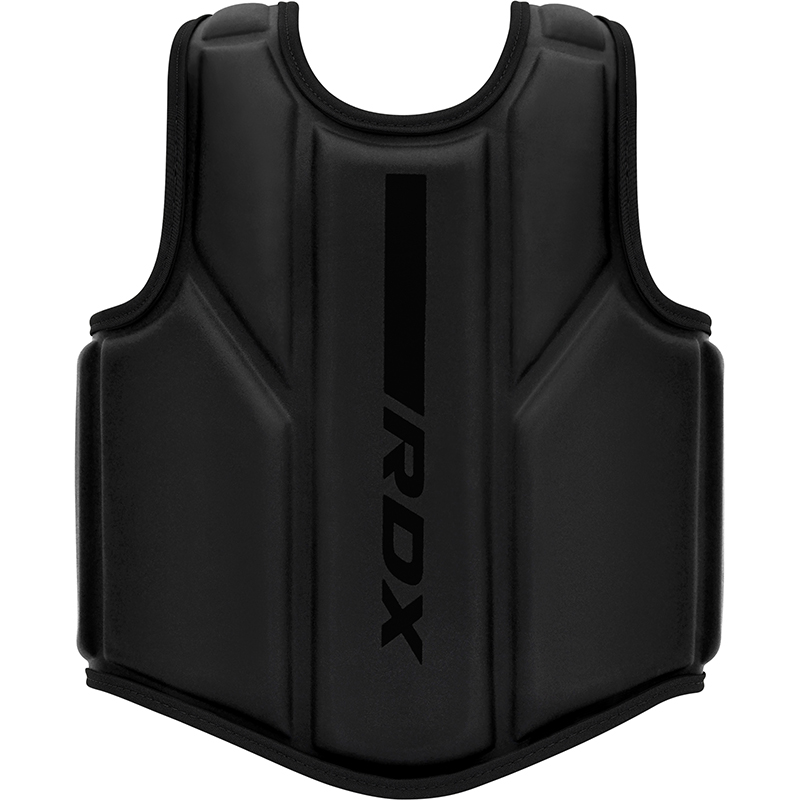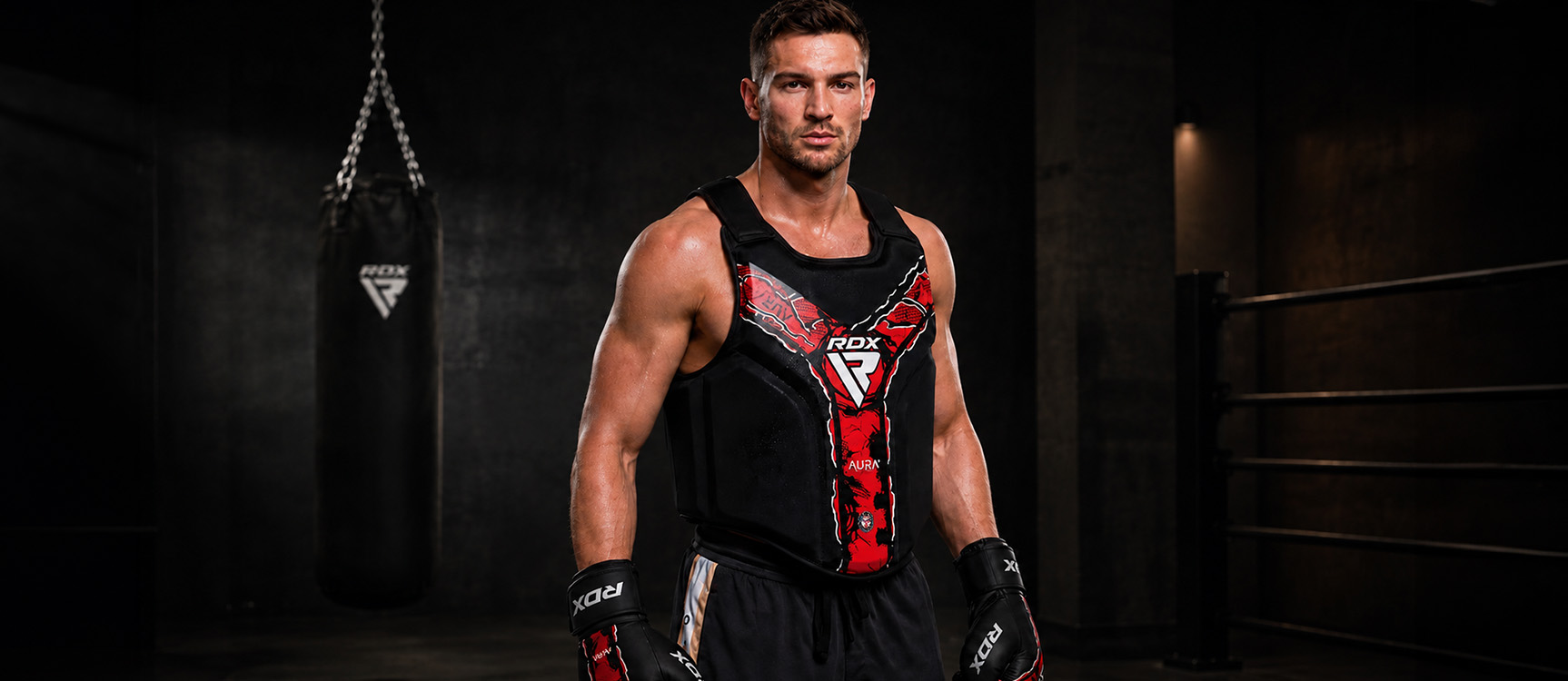
A chest protector protects the torso during practice of punches, kicks, and combinations. You’ll use it in combat sports such as boxing, kickboxing, MMA, karate, or taekwondo—whether as an active athlete during sparring or as a coach holding the pads and leading intense training sessions.
A properly chosen chest protector should absorb impacts to the chest, ribs, and abdomen, but at the same time, it must not unnecessarily restrict movement, breathing, or hand movement. Therefore, the decisive factors are not only the level of protection but also the fit, fastening, stability on the body, and suitability for a specific type of training.
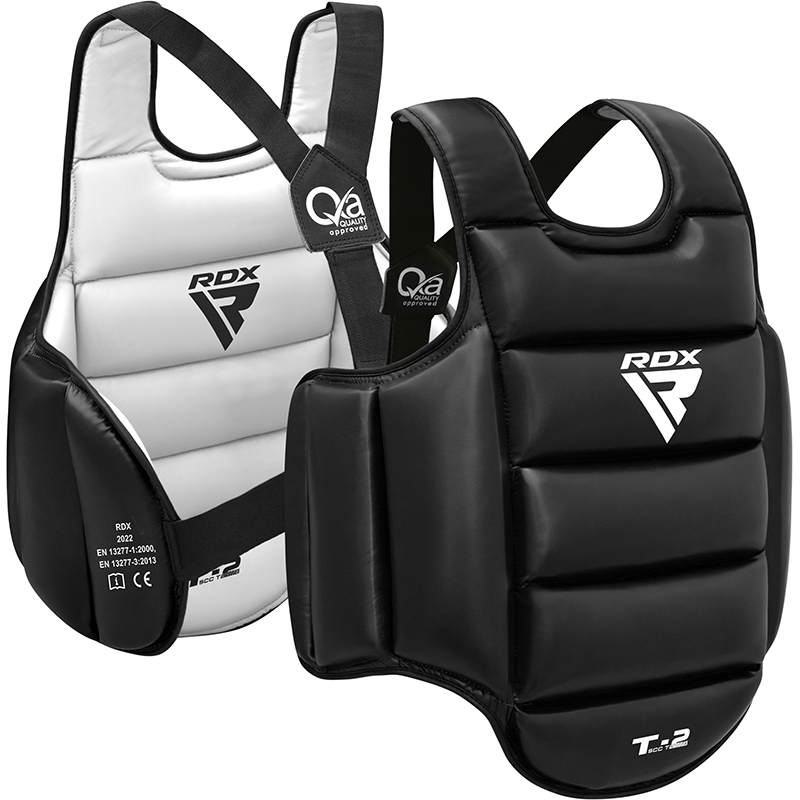
Choose a lighter, reversible chest protector that fits snugly and allows for free movement when kicking. The red-and-blue combination is practical and is used for both sparring and competition-style training.
Recommended product: RDX T2 Karate Chest Protector
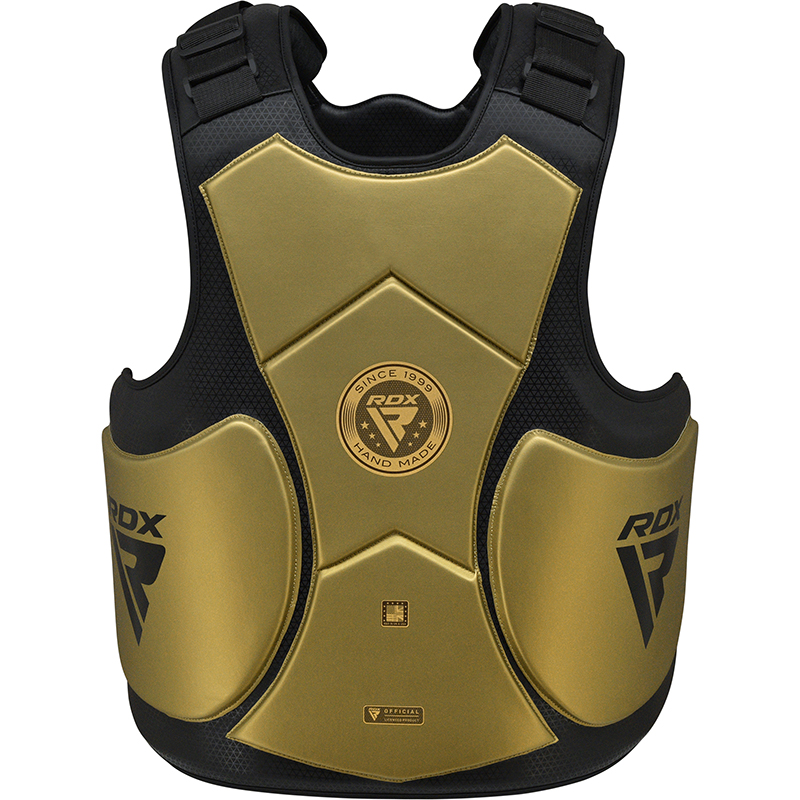
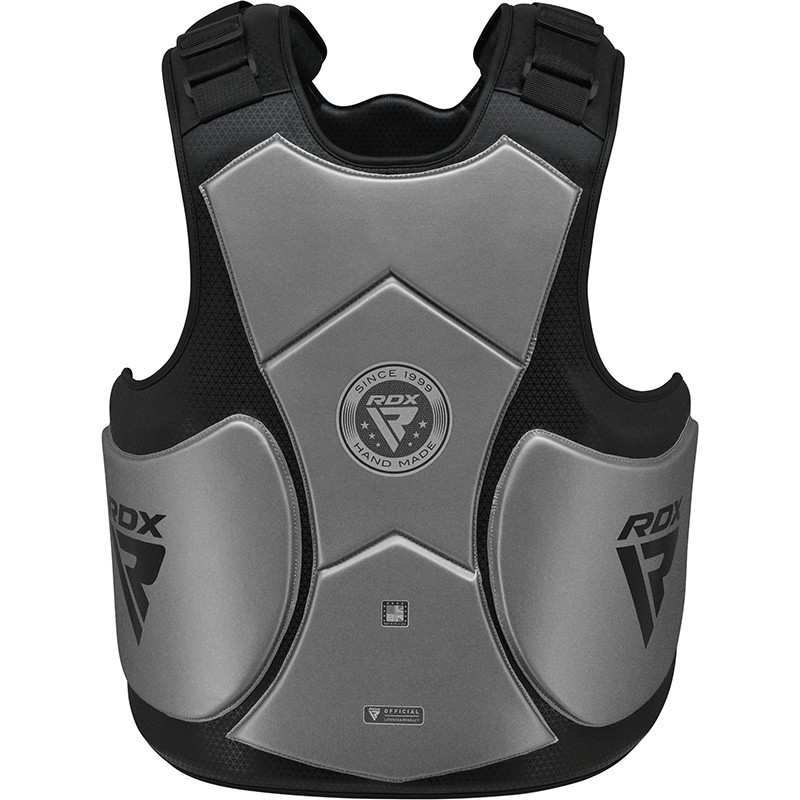
If you’re holding pads or doing more intense training, opt for a coach’s vest or body protector. These primarily protect the chest, ribs, and abdomen during body-targeted combinations.
Recommended products:
RDX F6M Kara Coach Chest Protector
RDX F6M Kara Coach Chest Protector MATTE GOLDEN PLUS, Black/Gold S/M
RDX F6M Kara Coach Chest Protector MATTE GOLDEN PLUS, Black/Gold L/XL
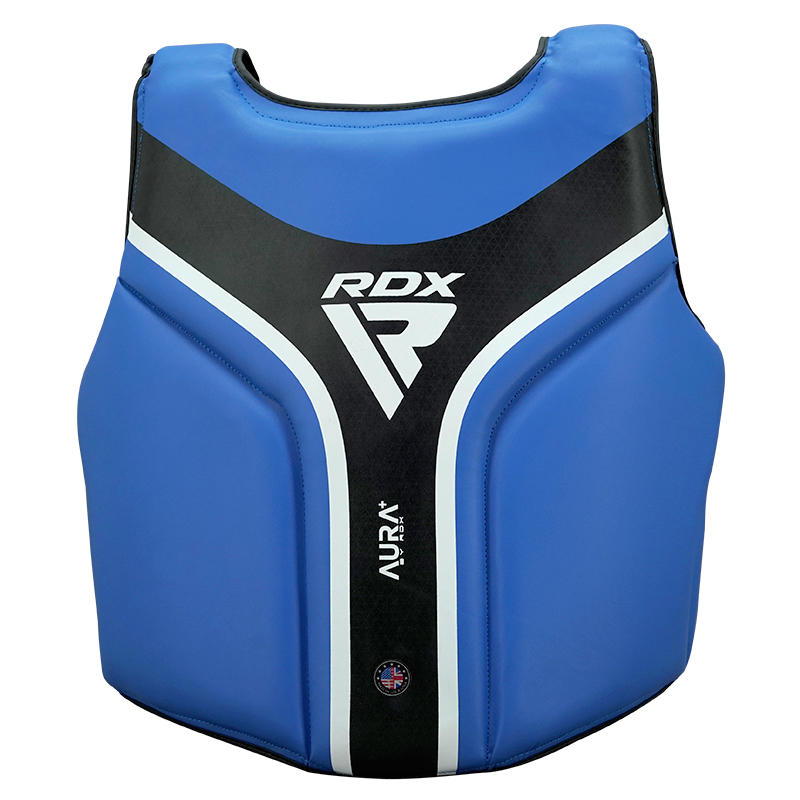
If you train frequently, throw harder punches, or do longer rounds, you’ll appreciate a sturdier construction, multiple layers of padding, and a secure fastening. These models are especially suitable for coaches, clubs, and advanced athletes.
Recommended products:
RDX AURA PLUS T-17 Chest Protector
RDX L1 Mark Pro Body Protector
RDX APEX Coach Chest Protector
RDX T15 Noir Chest Protector
Lighter Sparring and Kicking Disciplines
For taekwondo, karate, or similar sports, it’s important that the protective gear covers the torso without restricting movement. Lighter vests with good stability and sufficient cushioning against kicks are suitable.
Training with a Coach
If a coach is wearing the protective vest, it should be able to withstand repeated strikes to the body. Protection of the chest, ribs, abdomen, and solar plexus area is crucial. For coach vests, a sturdier construction and multi-layered padding are therefore recommended.
More Intense Club Training
For frequent use, look for models with a more durable outer material, sturdy stitching, high-quality fasteners, and padding that won’t wear out quickly after just a few training sessions.
The harder the contact, the more important it is to have denser, multi-layered padding. A basic body protector is sufficient for lighter training and controlled sparring. For coaches, pad work, and harder strikes to the body, a more robust body protector is better, as it distributes the force of the impact more effectively.
Be careful, however, not to choose a body protector that’s unnecessarily bulky. If it’s too heavy or bulky, it can restrict movement, handwork, and your natural stance. The ideal body protector is one that protects without getting in the way.
The protector must fit snugly, but not uncomfortably tight. It should not twist, slip down, or stick out when you move. At the same time, it must allow you to breathe freely, move your arms, and move your torso naturally.
When choosing a protector, pay particular attention to:
If you’re hesitating between two sizes, for coach’s vests it’s usually better to choose the option that offers sufficient coverage and allows the straps to be tightened securely. For sparring vests, on the other hand, it’s crucial that the vest doesn’t extend unnecessarily and doesn’t restrict movement.
A secure fit determines whether the protector will stay in place even during longer training sessions. Adjustable shoulder and back straps, Velcro fasteners, buckles, or a combination of multiple attachment points are practical features.
Always tighten the protective gear before training so that it fits snugly against your body. After a few punches or kicks, check to make sure it isn’t shifting. If the protective gear moves, its protective function is reduced.
Protective gear often uses synthetic leather, durable layered materials, and foam padding. It’s important that the outer surface can withstand repeated impacts and that the inner lining feels comfortable against the skin, even when you’re sweating.
After training, wipe the protective gear with a damp cloth and let it air dry thoroughly. Do not put it away in your bag while it’s still wet—this unnecessarily shortens the material’s lifespan and promotes odor.
✔ Once you’ve put on the protector, test it while moving
Try a few side steps, turns, forward bends, and shoulder movements. If the protector feels tight, slips down, or makes it hard to breathe, it isn’t adjusted properly or is the wrong size.
✔ Don’t underestimate the ribs and solar plexus during intense training
Strikes to the body often target the ribs, abdomen, and solar plexus area. For coaches and regular sparring partners, therefore, choose a chest protector that covers not only the chest itself but also the lower torso.
✔ Caring for your chest protector: how to extend its lifespan
After each training session, wipe down the protector with a damp cloth or a special disinfectant spray. Never put it in the washing machine or dryer—heat and mechanical stress damage the foam cores. Let the protector air dry in a well-ventilated area, not inside a closed gym bag—moisture is a breeding ground for bacteria and unpleasant odors. Store it away from direct sunlight, which degrades synthetic materials.
Do I need a chest protector even for light training?
For shadow boxing or non-contact technical drills, a chest protector isn’t necessary. However, as soon as you engage in any form of sparring or practice with a partner involving contact, a chest protector is essential—even for exercises that seem harmless. One unfortunate blow can break a rib.
What is the difference between a chest protector and a body protector?
A chest protector primarily covers the front of the torso—the sternum and ribs. It is lighter and designed primarily for competitors and trainees. A body protector covers the entire torso, including the hips, abdomen, and often part of the back—it’s more robust and primarily intended for coaches and sparring partners.
Can I use one protector for multiple sports?
Yes, high-quality RDX protectors are designed for a wide range of combat sports—boxing, karate, taekwondo, kickboxing, and MMA. Reversible models (such as the RDX T2) also offer color options for different competitions.
How can I tell if a protective pad is worn out and needs to be replaced?
Visible damage (cracks, peeling surface), significantly reduced elasticity of the foam core (the protector does not return to its original shape), and loose buckles or straps—these are all signs that it’s time to replace it. The average lifespan with regular training (3–5 times a week) is 2–4 years for standard models.
Does it make sense to buy a protector for children as well?
Definitely yes—children’s musculoskeletal systems are still developing, and injuries to the ribs or sternum can have long-term consequences. For children, choose smaller sizes (S/M) with soft padding and a simple fastening system that they can manage on their own.
Does the protector need to meet any certification standards?
There is no mandatory certification for training use. At WKF (karate) or WT (taekwondo) tournaments, approved models are required—check your federation’s current rules before the competition.

Built like a tank with sturdy, compressed padding layered on top of each other to protect your chest and ribs.

Chest protectors weren't designed to withstand such a punishment—until now. Show off your athletes' best moves with a chest protector that flawlessly…

It's still possible to maintain your routine and continue your professional training in boxing, karate, taekwondo, or martial arts outside the gym.

A blend of innovation and tradition. The latest RDX double-sided chest protector for taekwondo is designed to integrate the high-tech impact absorption of the modern world into a classically sturdy…

A favorite training tool for every fighter and a coach’s best friend, the RDX Mark Pro chest protector provides perfect protection and a comfortable feel during intense training sessions.

A favorite training tool for every fighter and a coach's best friend, the RDX Mark Pro chest protector provides perfect protection and a comfortable feel during intense training sessions.

Built like a tank with sturdy, compressed padding layered on top of each other to protect your chest and ribs.
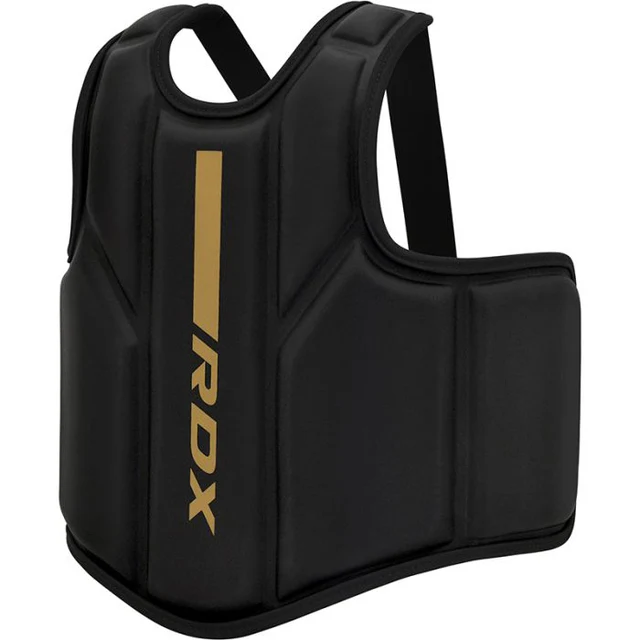
Practice your combinations and train twice as hard with the F-6 chest protector, which not only withstands impacts but also lasts longer than most other protective gear. Its unique strap system provides a comfortable yet secure fit, from the shoulders all the way to the back. Specially designed to disperse impact and withstand the strikes of an experienced fighter, this chest protector allows you to practice the strikes you’d use in a real combat situation. The result is a better, stronger, and more skilled athlete than before.

Practice your combinations and train twice as hard with the F-6 chest protector, which not only withstands impacts but also outperforms most other protective gear.
Practice your combinations and train twice as hard with the F-6 chest protector, which not only withstands impacts but also lasts longer than most other protective gear. Its unique strap system provides a comfortable yet secure fit, from the shoulders all the way down the back. Specially designed to disperse impact and withstand strikes from an experienced fighter, this chest protector allows you to practice strikes you would use in a real combat situation. The result is a better, stronger, and more skilled athlete than ever before.
Acra is a purely Czech brand that has been providing a full range of sports equipment for homes and rural playgrounds since 1991.
Customer Service Center
Feel free to write anytime
Call Mon–Fri, 6 a.m.–3 p.m.
Delivery Methods
Payment Methods